There is another set of assumptions, sometimes called the growth mindset, that says the self is not fixed. The mind can can grow and change. That which we dislike about ourselves can be altered through thought and effort. Breaking habits, changing conceptions, regulating emotions- None of these are easy to do, and their perceived difficulty increases with age. When we are young, change does not appear difficult because our lives change all the time. We face a new teacher each year, form and break friendships, grow in physical ways and adapt emotionally to new surroundings.
Wednesday, April 22, 2015
The Challenge of Change
Saturday, July 21, 2012
A Crisis of Faith in the Shower
This morning in the shower, I underwent a crisis of faith. I had gotten up groggily and entered the show, but as I stood under its downpour, it occurred to me that I wasn't sure whether I had taken a towel out of the cabinet before entering the shower. If I hadn't, I would have to walk a longer distance to the towel cabinet than I otherwise would go and drip heavily upon the floor as well. I thought at that moment: Well, I'll just have to believe that I did take out a towel. I'll have to have faith in myself.
At first, this struck me as analogous to believing in God, that belief in God is a sort of test of faith — With no empirical evidence, we ask ourselves to believe in something that we hope will be there for us when we need it.
After mulling over that for a moment, however, a more prescient analogy came to mind. I began to compare the towel to my preparation in being a teacher. I am starting my first teaching job in a month and I am scared. This is not an uncommon feeling among teachers or people new to things, but it is occupying my mind and even more of my dreams. I went through an excellent teacher-preparation program — one of the best — and I think I've come to work at a very supportive campus, but in the end , it's just you and the kids, alone in the classroom.
Back to the analogy, I thought: My teacher preparation is like the towel. In the end, I'll just have to have faith that what I've learned and experienced will be enough. I have to believe that my former self made enough preparations for me to succeed. This is a modicum of comfort to my anxieties, and for that, I am grateful. We'll see as my year progresses how much my faith will be justified.
Incidentally, upon leaving the shower, I discovered that I had taken out a towel.
Thursday, December 29, 2011
Zombies are bad at math
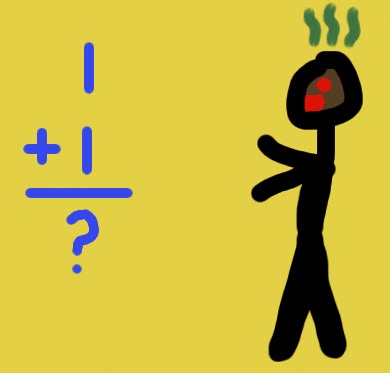
Have you ever given a zombie a calculus problem? Of course not! Why? Because zombies are bad at math. You'd never go to a brain-eating monster for help in your statistics course. A zombie wouldn't have the slightest idea how to find the hypotenuse of a right triangle; only a great fool would ask one how many sides a hexagon has.
And don't even get me started on algebra. If you walk up to a zombie and ask him to factor a polynomial, he'll look at you like you're out of your mind, and then shortly try to get your mind out of you.
Zombies are good for a few things. If you want some human brains eaten, zombies are the way to go. If you're looking for a fast way to spread a virus that will wipe out human civilization, you can't do better than a zombie plague. Heck, zombies are even good for fueling the plots for any number of movie and television franchises. But if you're in the market for something do some arithmetic, look somewhere else.
Saturday, December 24, 2011
What does it mean to be objective?
You know what's really annoying? People who answer their own questions in writing. You know what else? Subjectivity. Subjectivity (named for the Roman philosopher Subjectavius) was formed out of a desire for the patricians of the Roman Empire to receive their news in a way that didn't include all the stuff they didn't want to hear about. Roman Phalanxes, the news-bearing section of the Roman army, learned quickly that if they only told about the victories and left out the defeats, the powers-that-be back home were a lot more willing to send them back with their pockets heavier with gold and their bellies heavier with festive feast fare.
Soon enough, civilian news organizations began to get in on the game, distributing as many versions of the news as they could find a market for. At the height of the trend, a Roman family could receive a newspaper declaring their loved one's victory over the lion in the Colosseum, mere moments after said loved one has been ripped to shreds upon the lion's gnashing maw.
Since this early history, subjectivity in journalism has been the mainstay, with media catering to every set of political, religious and ethnic opinions being produced across the world. Subjectivity isn't always as obvious as it once was; some media pieces can seem very fair to the untrained eye and still be rife with bias.
But all is not lost in this subjective world we live in. In recent years, there has been a growing movement to reclaim objectivity, to say to the world, "I'm going to tell you what's what without telling you what I want you to hear." This humble and magnificent blog is just one soldier (but probably like an admiral, at least) in the fight to restore the truth as it should stand: objective.
-Benjamin Miller
Any facts contained within this article are inadvertent and should be disregarded. The author apologizes for these mistakes.
Soon enough, civilian news organizations began to get in on the game, distributing as many versions of the news as they could find a market for. At the height of the trend, a Roman family could receive a newspaper declaring their loved one's victory over the lion in the Colosseum, mere moments after said loved one has been ripped to shreds upon the lion's gnashing maw.
Since this early history, subjectivity in journalism has been the mainstay, with media catering to every set of political, religious and ethnic opinions being produced across the world. Subjectivity isn't always as obvious as it once was; some media pieces can seem very fair to the untrained eye and still be rife with bias.
But all is not lost in this subjective world we live in. In recent years, there has been a growing movement to reclaim objectivity, to say to the world, "I'm going to tell you what's what without telling you what I want you to hear." This humble and magnificent blog is just one soldier (but probably like an admiral, at least) in the fight to restore the truth as it should stand: objective.
-Benjamin Miller
Any facts contained within this article are inadvertent and should be disregarded. The author apologizes for these mistakes.
Thursday, March 31, 2011
Perspectives on Death
In the light of the string of recent tragedies (Japan, Libya, that kid who died after winning a high-school basketball game), I have once again been thinking about how much life is worth.
It is clear to me that every life is inherently valuable, but is it possible or preferable to consider one life more valuable than another? And if so, what standards should we use to differentiate one life as more valuable with another?
I think the inherent reaction of the mostly unprejudiced individual is to say that all lives are equal. After all, it is a founding principle of this country that "all men are created equal". This is what I agree with. And yet, in practice, I have found that the opinion of many that I have encountered is implicitly discriminatory in the value of life. In the story of that kid who died after winning a basketball game that I mentioned earlier, I have found many people saddened by the event, people who, as I might add, are emotionally independent to far worse xor equal tragedies. While this personally doesn't affect me — I, for one, find dying after winning a basketball game a pretty decent way to die, even at such a young age — I do find myself more concerned about the multiple tragedies in Japan than any other disasters, both recent and ongoing. I feel worse for a Japanese person dying than any African child, though I should value them equally.
I find this inconsistency troubling. I would like to continue to believe that all lives are equal and therein be able to dismiss anyone trying to make me feel bad about the death of a famous person or a particular group of people as no more worthy of my grief than starving children in Africa or executed political prisoners or babies dying of SIDS. It is in this way that I can avoid feeling negative emotion for something that does not affect me. But this real concern I have for the Japanese people along with my desire to be unaffected would require a degree of cognitive dissonance that I am not comfortable having.
I don't know what to do about this but I hope a solution will come to me.
It is clear to me that every life is inherently valuable, but is it possible or preferable to consider one life more valuable than another? And if so, what standards should we use to differentiate one life as more valuable with another?
I think the inherent reaction of the mostly unprejudiced individual is to say that all lives are equal. After all, it is a founding principle of this country that "all men are created equal". This is what I agree with. And yet, in practice, I have found that the opinion of many that I have encountered is implicitly discriminatory in the value of life. In the story of that kid who died after winning a basketball game that I mentioned earlier, I have found many people saddened by the event, people who, as I might add, are emotionally independent to far worse xor equal tragedies. While this personally doesn't affect me — I, for one, find dying after winning a basketball game a pretty decent way to die, even at such a young age — I do find myself more concerned about the multiple tragedies in Japan than any other disasters, both recent and ongoing. I feel worse for a Japanese person dying than any African child, though I should value them equally.
I find this inconsistency troubling. I would like to continue to believe that all lives are equal and therein be able to dismiss anyone trying to make me feel bad about the death of a famous person or a particular group of people as no more worthy of my grief than starving children in Africa or executed political prisoners or babies dying of SIDS. It is in this way that I can avoid feeling negative emotion for something that does not affect me. But this real concern I have for the Japanese people along with my desire to be unaffected would require a degree of cognitive dissonance that I am not comfortable having.
I don't know what to do about this but I hope a solution will come to me.
Friday, March 11, 2011
I cannot stand insipidity
I have a pretty high tolerance for annoying characteristics: I can bear the overly religious, argumentative, and even, to a lesser degree, boring. But I cannot deal with insipidity and hold my tongue for too long. It is simply not in my nature.
Some signs of insipidity:
Repeating things after they occur with marginally different wording in an attempt to make them funny.
Attempts to dismiss criticism through ad hominem attacks.
Prone to use catch-phrases. Sometimes uses quotes from popular media or memes.
They like to complain about their life.
They often talk about the lives of celebrities.
They give the impression of being extremely fake. This is largely a result for their desperate need to belong, which requires them to adapt to whatever is cool at the moment. For example, one such person recently was talking about how "ghetto" they were during her childhood.
They're really into bad music, such as '90s pop music and mindless hip-hop.
They're just really stupid.
So used to going unchallenged in social circles that they may overreact when called out.
If you see someone who displays these characteristics, you can recognize them for the empty-headed fools they are. If these describe you, stay away from me, or sooner or later, my words will siege you.
Some signs of insipidity:
Repeating things after they occur with marginally different wording in an attempt to make them funny.
Attempts to dismiss criticism through ad hominem attacks.
Prone to use catch-phrases. Sometimes uses quotes from popular media or memes.
They like to complain about their life.
They often talk about the lives of celebrities.
They give the impression of being extremely fake. This is largely a result for their desperate need to belong, which requires them to adapt to whatever is cool at the moment. For example, one such person recently was talking about how "ghetto" they were during her childhood.
They're really into bad music, such as '90s pop music and mindless hip-hop.
They're just really stupid.
So used to going unchallenged in social circles that they may overreact when called out.
If you see someone who displays these characteristics, you can recognize them for the empty-headed fools they are. If these describe you, stay away from me, or sooner or later, my words will siege you.
Friday, March 4, 2011
An Argument for Lazyocracy
I recently failed to vote in UT's local student election. It's not that I didn't want to vote. Even though I'm certain my vote doesn't matter and most of the candidates don't seem any worse than any other (with the exception of UT's secret society "The Eyes of Texas"-backed candidates), I make it a point to vote whenever possible. The more I vote, I figure, the more my demographic will be catered to by whoever is elected. It's the same reason that Jewish voters have a larger political influence than their population- A higher percentage of them vote.
The reason I failed to vote in this recent election was that I was simply so busy that I forgot. Voting, for all the attempts that groups have made to make it not so, is just too inconvenient. I wish I could just wake up, and while I'm getting ready for school, I would be offered the option to vote.
If between breakfast and the time it takes me to get to class, I could have a radio program read me the candidates' names, their positions on the important issues, and their qualifications, and I could call in and vote; if when I got to class, during my lunch break, an announcement would remind me and the rest of the school that we could vote online or at any of the convenient polling places in our area; if when I got home, my TV show was preceded by an advertisement that reminded me to vote and provided a venue for doing so; these would remove difficulty from the voting process and leave out only those who do not want to vote for specific reasons.
There are, of course, logistical issues with all of these, and I am not saying that a transition from our current system will be easy or, at this point, necessarily cost-effective and worth doing at this time. But I believe that this is a goal we should work toward.
If it were as easy to vote as it is to see a movie, and if society said that voting was an important thing to do as a citizen in a democracy, that would make democracy more fair. This is lazyocracy and, I hope, the future.
The reason I failed to vote in this recent election was that I was simply so busy that I forgot. Voting, for all the attempts that groups have made to make it not so, is just too inconvenient. I wish I could just wake up, and while I'm getting ready for school, I would be offered the option to vote.
If between breakfast and the time it takes me to get to class, I could have a radio program read me the candidates' names, their positions on the important issues, and their qualifications, and I could call in and vote; if when I got to class, during my lunch break, an announcement would remind me and the rest of the school that we could vote online or at any of the convenient polling places in our area; if when I got home, my TV show was preceded by an advertisement that reminded me to vote and provided a venue for doing so; these would remove difficulty from the voting process and leave out only those who do not want to vote for specific reasons.
There are, of course, logistical issues with all of these, and I am not saying that a transition from our current system will be easy or, at this point, necessarily cost-effective and worth doing at this time. But I believe that this is a goal we should work toward.
If it were as easy to vote as it is to see a movie, and if society said that voting was an important thing to do as a citizen in a democracy, that would make democracy more fair. This is lazyocracy and, I hope, the future.
Subscribe to:
Comments (Atom)